
20 februari 2026 | 7 min läsning
PAAM – Conference report
Talk News
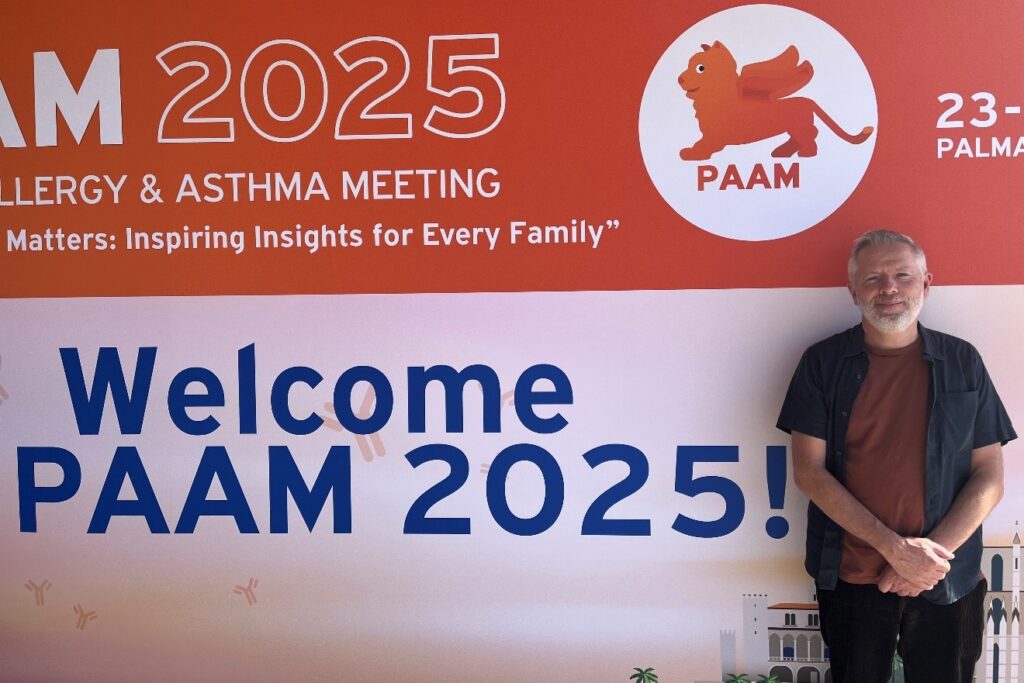
Palma de Mallorca, 23-25 October 2025
Going to Palma de Mallorca in late October is always a welcome change of climate for a Scandinavian. However, as I was there to attend the 8th Pediatric Allergy and Anaphylaxis Meeting (PAAM), most of my three days were spent indoors at the elegantly designed Palau de Congressos. Here are some of my most important take-home messages from the meeting.
OIT beats EPIT
In a pro–con session with Philippe Eigenmann and Helen Brough, the latter convincingly defended oral immunotherapy (OIT) over epicutaneous immunotherapy (EPIT) as treatment of food allergy. EPIT involves wearing a patch, much like those used by dermatologists to test for contact allergy. While the method is theoretically appealing, studies so far show it to be less efficient than OIT, and not necessarily better in safety terms. The possible niche for EPIT may lie in very young preschoolers—but postponing more effective treatment risks missing the ’golden window’ of immune plasticity in toddlerhood.
Food ladders work for egg and milk allergy
In another pro–con debate, Jonathan Hourihane made a compelling case for food ladders as a safe, family-centred, and empowerment-oriented approach. Food ladders involve introducing baked forms of an allergenic food into the child’s diet and then gradually “moving up the ladder” to less heated forms, with the goal of promoting tolerance. According to Dr Hourihane, it can even be applied in children who have previously experienced anaphylaxis. The key is to start as soon as the diagnosis is made, since every additional month an elimination diet may worsen the allergy.
Slow introduction could replace food challenges in mild FPIES
Anna Nowak presented data from her group in New York supporting slow home introduction of trigger foods in mild FPIES (Food Protein Induced Entereocolitis Syndrome). Gradual reintroduction at home seems to be safe and may be preferable to the rather cumbersome hospital-based challenges. Children with milk or egg FPIES often tolerate baked forms, making the food ladder concept feasible. Dr. Nowak recommends waiting at least six months after the last reaction and prescribing oral ondansetron for use in case of reactions.
Adrenaline – not always IM
In a session about anaphylaxis, Paul Turner showed that stroke volume drops significantly during anaphylaxis regardless of severity. This cardiac suppression responds poorly to the intermittent surges of adrenaline seen with autoinjectors but better to continuous infusion, which underpins the new UK guidelines recommending IV adrenaline infusion when reactions do not improve after two IM doses. He also discussed the newly approved intranasal route for adrenaline administration, now supported by small case series and real-world evidence. Intranasal treatment may encourage better carriage, reduce “adrenaline anxiety,” and promote earlier use, although questions remain about the extent to which intranasal adrenaline can replace the IM route. In the same session, M. Anagnostou noted that the risk of fatal anaphylaxis from food allergies is very low, similar to the general risk of dying in a house fire or homicide. However, as Dr. Turner pointed out, carrying adrenaline is not only about avoiding death but also about empowerment and living a normal life.
OIT – how low can we go?
The first OIT trials used food doses in the gram range. Newer studies have shown that maintenance doses as low as 300 mg can be equally effective while causing fewer allergic reactions. So how low can we go with OIT doses? Thomas Eiwegger presented a brand-new Canadian trial showing that even 30 mg of maintenance protein (about 1/8 whole peanut) in infants 6–15 months can lead to desensitization and also modulate biomarkers like s-IgE and s-IgG4 comparably to 300 mg. It is still unclear whether it can lead to a lasting remission, which was the theme of the lecture by Carmen Riggioni-Viquez. Remission is defined as tolerance of the allergenic food even after stopping OIT, which is thought to be mediated by T-cell reprogramming, microbiome shifts, and epithelial repair. Young children with low s-IgE are more likely to achieve remission, which improves quality of life more than simply increasing allergen tolerance through ongoing OIT.
Contact allergy is for allergists, too
Contact allergy is within the realm of dermatologists, but we allergists need to be aware of potential contact allergens in order to differentiate from atopic dermatitis. Anne Barbaud described allergens such as isothiazolinones from headphone padding, acetophenone azine in football shin guards, and even protein-related contact dermatitis, often not detectable with a patch test but with the allergist’s classic tool, the prick-to-prick test. Protein contact allergy can be caused by food-derived proteins, such as fish, shellfish, flour, grain and potato.
How to address pediatric mastocytosis
In his lecture about pediatric cutaneous mastocytosis, Vito Sabato highlighted that abdominal ultrasound, along with serial serum tryptase, is a useful and non-invasive tool to assess systemic disease, which of course is rare since most pediatric mastocytosis will resolve before adolescence. KIT mutations in blood suggest systemic disease but should not be routine testing, since it is not in itself an indication for treatment (cytoreduction). On the same subject, Patrizia Belladonna reminded us that looking for mediator (ie, histamine) symptoms is an important aspect of pediatric cutaneous mastocytosis. Specifically, flushing reflects systemic vascular involvement and warrants treatment with antihistamines, and occasionally the prescription of an adrenaline pen. Mediator symptom severity often correlates with both skin extent and tryptase level.
Atopic dermatitis is not caused by allergy – or is it?
In a pro–con session about allergy testing in atopic dermatitis (AD), Anne Barbaud emphasized that AD is primarily an inflammatory skin disease, not allergic. However, autoallergy -a concept we have come to know from chronic spontaneous urticaria- is increasingly recognized as part of AD. Philippe Eigenmann reminded us that in selected, treatment-refractory young children with AD, testing for milk, egg, and wheat can still be relevant, given the acute, intermediate and delayed food responses observed in the landmark studies by Sampson and coworkers (including Dr. Eigenmann himself).
All in all, it was a great meeting, full of learning, networking and socializing. The PAAM congress has the size and impact to attract the best lecturers from Europe and beyond, and yet it is small enough to allow you to actually meet people. I warmly recommend it to everybody who works in the field of pediatric allergy.
Henrik Herløv-Nielsen
Överläkare, barnallergolog
Barnallergimottagningen, Helsingborgs Lasarett